
The year is 1995. Tom is in excruciating pain. His right arm hurts like it’s on fire!
Tom is a retired veteran who fought in the Vietnam war.
Here’s the thing though - Tom doesn’t have a right arm. Not really. His right arm was amputated in 1994. It’s this non-existent arm that’s the bane of Tom’s existence right now. It’s this non-existent arm that’s got him taking enough opioids to sedate a small-town zoo.
Tom is depressed. He’s on anti-depressants on top of taking high-dose opioids. Pain is bad enough - but a man like Tom - a soldier - is no stranger to pain. Pain is not something that depresses men like Tom. But this was different - This was pain in a body-part that just wasn’t there.
Imagine that for a second - you go out to fight a war for your country - you get shot in your arm.
That’s bad enough right?
Now, it doesn’t end there - the arm needs to be removed. Terrible, yeah?Except - it doesn’t end there either - this arm that’s been amputated continues to hurt with the same exact intensity it did in THAT moment.
The moment when it all changed. An excruciating, ever-present reminder of the single worst moment of your life - you get why he was depressed, don’t you?
And this was at a time when we didn’t understand the phenomenon of phantom limbs the way we do now. And this story is actually central to how the scientific community came to its current understanding of phantom limb pain.
Now we cut to Dr.V.S.Ramachandran, the protagonist of this story, if you will. Dr.Ramchandran was an Indian-born neuroscientist who was working at the UC San Diego at the time.
Dr.Ramchandran was a scientist of the Newtonian, Darwinian, Huxleyan ilk - A true student of the natural world. A man driven by curiosity and with no regard for the interdisciplinary boundaries imposed by humans on science.
This was a man who didn’t get the memo that science had long since stopped being about the sincere, child-like pursuit of answers about how the world works. This was a man who just wasn’t wired to care about things like a department’s prestige or looking good to donors.
Dr.Ramchandran was particularly fascinated by the human brain. It was this fascination that had led him to pursue neuroscience as a vocation - a decision that had baffled his parents, peers and friends to no end. It simply didn’t make sense to people why a doctor who had graduated from one of India’s most elite medical institutions would choose to pursue something like neuroscience. Not neurology - neuroscience!But this was not a man who made his decisions based on expediency or pragmatism.
When Dr.Ramachandran met Tom for the first time, he had already been working on the phantom limb phenomenon for a while. You see - people have known about phantom limbs for centuries if not millennia - the phenomenon wasn’t unheard of - but even as recently as the 1990s we didn’t really know the why and the how of this bizarre phenomenon.
Phantom-limb pain - especially chronic, unrelenting pain after amputation - posed both a medical and scientific mystery - how could pain persist when the body part was gone? Solving this problem promised rich insights into the inner workings of the human brain.
Through most of the 20th century, the popular consensus around phantom limbs among scientists was that it was a result of issues at the site of the injury - residual nerve damage, nerve growths etc. It wasn’t until the late 80s and early 90s that scientists, led by Ronald Melzack started getting behind a theory that placed the brain at the centre of this mysterious phenomenon.
The 1990s were dubbed “The decade of the brain” - billions of dollars were being poured into brain research. Governments and scientists alike were convinced that the next big wave of era-defining answers would come from unravelling the mysteries of the brain. This meant that multi-million dollar scanners and brain imaging technologies were the norm in the world of brain research at the time. University laboratories were busy stockpiling billions of dollars worth of equipment.
Dr.Ramachandran was convinced that the phantom limb phenomenon was rooted in the brain’s mapping system - you see, the whole body’s structure is mapped onto the brain. When we feel pain in our right index finger, say, there’s a corresponding activation in the region of the brain associated with the right index finger on the brain’s full-body map.
After pouring over Tom’s case for a while, Dr.Ramachandran was convinced that he had the answer not just to Tom’s debilitating situation but also to the phantom limb question at large. When the bullet had hit Tom’s arm - the pain receptors in his arm had sent a distress signal to his brain’s sensory cortex - which had responded with pain signals back - this is literally the body’s way of protecting itself - pain is the way the body stops us from doing things that threaten the integrity and safety of our physical structure.
In typical cases, the brain would use various streams of data to confirm that the situation had passed and then would send a stop signal, as it were. Dr.Ramachandran’s theory was this - in Tom’s case, the brain didn’t have access to the data stream it prioritised over all others - the visual stream. Typically, when the brain sees that a body part which has suffered a serious injury is healthy again, it uses that data to feel safe about sending a STOP signal that terminates the pain response. In Tom’s case, the brain literally couldn’t complete that feedback loop - there was no arm - the last visual feed that the brain had received of the arm was that of the arm having taken a bullet. In other words, the brain was waiting for visual data that would confirm that the incident had passed - Data that would never come because the arm had been amputated.
Dr.Ramachandran was convinced that if he could somehow find a way to trick Tom’s brain into seeing a virtual reality in which Tom’s right arm was healthy and functioning, the loop would complete and the excruciating clenching and pain would stop. This was pure scientific intuition - a hunch. He had no way to convince people that it would work. But he was convinced that this was the missing puzzle piece - he just needed to find a way to prove it to himself and the world.But how?He couldn’t afford to set up a multi-million dollar virtual reality rig that would help him feed a fabricated visual input into Tom’s brain. So what could he do?
He built his own solution. For the princely sum of 2.50$, no less!
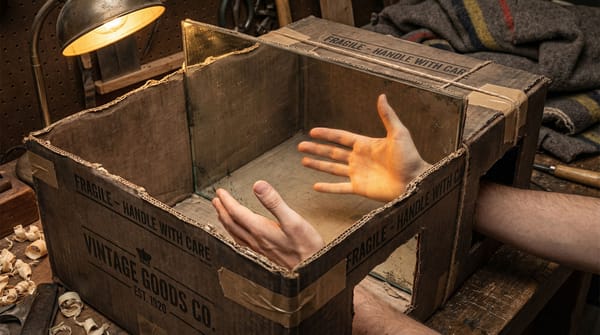
Ramachandran took a cardboard box and fitted it with a mirror placed in such a way that when Tom would put his left arm into the box, the mirror would project a reflected right hand onto the space where there was only a stump now. When Tom put his hand into the box, his brain, for the first time in years, saw an image of two healthy hands. The unclenching was instantaneous! When Tom moved his left hand, his brain saw an image of two hands moving in accordance to its commands - boom - the pain disappeared!
Dr.Ramachandran had done the impossible - he’d solved the mystery of phantom limb pain with a makeshift piece of equipment costing 2.50$! He’d done with 2.50 $ and audacity what scientists were trying to do with billions of dollars worth of equipment.
Tom’s story, on one level, is nothing short of miraculous. Not miraculous in the sense of something supernatural. Miraculous in that - human ingenuity, when freed from arbitrary constraints - is miraculous. There is a distinct flavour to the effect these stories have on the human system - that unmistakable sense of relief, joy,wonder and utter satisfaction that floods the system when we so much as hear stories of human ingenuity - of sense - of coherence.
That exquisite feeling of the nervous system just dropping guard - almost like it goes “yes! This is how things are meant to work!”
This coherence we speak of, is the beating heart of this publication. In other words, sense is what NOUS is about. The mirror box isn’t really about phantom limbs - or neuroscience even - it’s about something far more foundational and fundamental. At its core, the mirror box is a metaphor for sense itself. For a certain kind of approach to life and to solving problems - cutting to the core of things - the indivisible essence.
We think sense is about reducing things to their simplest form. We think intelligence is about simplicity - not complexity. In fact, that’s a great way to define intelligence - that which collapses the complex into the simple.
Feynman was famous for this - if he couldn't explain something in simple terms, he knew he didn't really understand it. Not dumbing down, but finding the elegant core - finding what’s essential.
This is what we mean by sense.
Sense isn't about complexity or sophistication. It's about cutting to the indivisible core of things. The mirror box didn't require advanced technology or elaborate theory - it required seeing the actual problem clearly. Tom's brain needed visual confirmation. Give it visual confirmation. Done.
This is what NOUS is about - finding that elegant core. Finding that powerful reframe that forces complexity to collapse. Finding that approach that results in massive disruption with the least amount of intervention.
We believe intelligence is fundamentally about collapsing complexity into simplicity. Feynman understood this - if he couldn't explain something in simple terms, he knew he didn't really understand it. Not dumbing down, but finding what's essential.
The mirror box cost $2.50 because Ramachandran understood the problem at its root. The billions spent on brain imaging equipment weren't solving phantom limb pain because they were addressing the wrong level of the problem. They were adding complexity where simplicity was needed.
That's what sense looks like in practice: the audacity to ask "What's actually happening here?" and the clarity to act on the answer.Welcome to NOUS!