

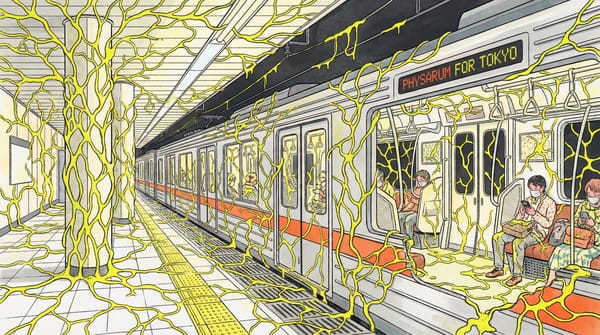
Tokyo Metro.
An absolute monument to human ingenuity, cross-generational continuity and planning. Every day, 6.52 million people descend into Tokyo’s underground labyrinth and emerge exactly where they need to be, exactly on time.
Nine lines, 180 stations, 195 kilometres of railway tracks coursing through one of the planet’s most densely populated urban centres.This was Asia’s first ever underground rail network when it opened back in 1927.
Over these 99 years, the system has seen continuous expansion - it’s almost always under construction. Decades of engineering expertise, urban planning, iterative redesigning and tons of computational modeling have gone into making this system what it is today, Billions upon billions of dollars have been spent on it. The accumulated expertise of multiple generations has gone into making this system what it is.
The system is ridiculously precise.
So precise that when in 2018, a train departed 25 seconds ahead of schedule, West Japan Railways issued an official apology for the error which they publicly admitted was a “truly inexcusable” one!
That’s the standard the system holds itself to. A system so intricate and with so many moving parts that it simply baffles the mind.
Slime Mould
Physarum polycephalum.
Commonly known as the slime mould. An organism with no brain. No neurons. Nothing resembling a nervous system. A single-celled organism that is simply a branching network of protoplasm - the gooey stuff inside our cells - growing out through its environment searching for nutrients.
An organism that isn’t a plant or an animal or a “being” in any intuitive sense. A form of life so simple that it’s almost impossible not to see it as a biological program.
Hokkaido Team
In 2010, a team of researchers from Hokkaido University were absolutely fascinated with the slime mould. You see, the slime mould was a bit of a celebrity species in Japanese science circles. In the year 2000, a Japanese researcher named Toshiyuki Nagasaki famously showed that the Physarum could solve mazes. He’d placed nutrient sources at two ends of a maze and watched in awe as the slime mould simply grew in such a way that it found the shortest possible path to the other side of the maze.This was pathbreaking stuff - it showed that a brainless, single celled organism could solve a spatial problem that usually requires computation.The Hokkaido team wanted to know if this also extended to more complex network problems.
They wanted to see what would happen when this brainless organism encountered a problem as complex as theTokyo Metro!The same spatial constraints, the same distribution of resources, that Tokyo’s engineers had spent decades optimising for - a problem that took multiple generations of human genius and billions of dollars to solve.
The Experiment
Led by Atsushi Tero, with Nagasaki involved, the team decided to set up an experiment to find out if the slime mould’s ability could scale up from finding the shortest path between two points to designing an entire optimised network connecting 36 points.
A large wet agar plate was set up. Wet agar is a simple nutritional medium commonly used to grow fungi. The wet agar plate was essentially a nutrient gel in a petri dish, about 20 cm wide, that gave the slime mould a moist surface to move across.Now, they placed 36 oat flakes on the agar plate in a pattern that precisely matched the geographic spread of the cities in the Greater Tokyo Area. Oat flakes are a preferred food source of the Physarum - highly digestible and nutrient-dense. Each flake corresponded to a major hub on the network. A sample of Physarum polycephalum in its plasmodial state - the bright yellow, visible-to-naked-eye form. They placed it at the center position corresponding to Tokyo itself. This is a single cell, but it's multinucleated (thousands of nuclei sharing one cytoplasm) and can grow to the size of your hand.
Intelligence ≠ brain
The slime mould first started sending our thin tendrils in all directions from the Tokyo centre point. It was exploring the terrain - foraging - sending out feelers to locate food. By hour 10 the tendrils started reaching the oat flakes - i.e. the “cities”. As each tendril made contact with the food, it would envelop the food and start digesting it. At this point, the slime mould had a whole sprawling network of tubes going out of its main “body”, connected to various sources of food. This is where things get truly astounding. The slime mould started pruning the network!
Tubes carrying high volumes of nutrients were prioritised and those that saw low-traffic were decommissioned, as it were. The high-traffic tubes became thicker and started expanding. Thel low traffic tubes contracted and eventually disappeared. A purely physical process. No brain involved. What’s stunning though is that by hour 26, what remained was an elegantly clean network. The sprawling chaos had been resolved into a sensible structure of thick primary tubes connecting the major food sources (cities) with thinner secondary connections providing redundancy. When the researchers compared this final network to the actual Tokyo rail system, they found
Topology matched:The major connections were nearly identical
Efficiency comparable: Travel times/distances between nodes were similar
Fault tolerance comparable: The network could lose connections and still function
Cost comparable: The amount of "material" used (tube length/thickness) was similar to the rail infrastructure costMultiple trials were conducted and they had slight variations but when the slime mould chose a different route, it turned out that the alternative was equally efficient!
Let that sink in
A brainless organism, operating purely through physical response to nutrient gradients, arrived at the same solution that took human civilization a century and billions of dollars to develop.But here's what we need to understand:
This isn't a story about a clever slime mould.This is a story about what intelligence actually is.
The Frame Collapse
We think intelligence is something that happens in here - in brains, in neurons, in the computational theater of consciousness. We think solving complex problems requires planning, modeling, calculating optimal solutions.
The Tokyo Metro seems to prove this. Look at all that expertise! All that planning! All those engineers with their degrees and their models and their decades of iterative refinement!
But the slime mold reveals something else entirely.
The Tokyo Metro's efficiency isn't the product of human genius inventing an optimal solution. It's the product of human genius recognizing what reality was already showing.
The constraints were always there:
Population distributed across geographic space
Need to connect these points efficiently
Minimize cost (tube length, infrastructure investment)
Maintain redundancy (fault tolerance)
These aren't human inventions. These are features of reality itself when you're trying to move things (nutrients, people) between distributed points (food sources, cities) in physical space.
The slime mold doesn't "solve" this problem. It responds to it. High-traffic routes get reinforced by nutrient flow. Low-traffic routes atrophy from lack of use. Pure physics. Pure feedback.
The Tokyo planners didn't "solve" this problem either. They responded to population density, geographic constraints, cost pressures, failure scenarios. They tested routes. They refined based on what worked.
Both systems converged on the same solution because they were both responding to the same underlying reality.